
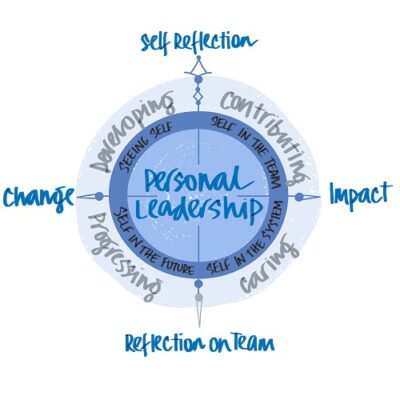
THE PERSONAL LEADERSHIP MODULE IN 3 SENTENCES
Personal Leadership is developed on an understanding of your values and how these values impact your behaviour and impact.
Personal Leadership is a journey of discovery into your current and desired communication impact across areas of your life that matter to you.
Personal Leadership is an opportunity to explore blind spots and areas of strength to enable you to be the best leader you want to be in all parts of your life.
LEARNING INTENTIONS FOR THIS MODULE
Convene as a learning group.
Introduce the concept of Thinking Space, Thinking Partners, and Rules of Engagement.
Connect to values, reflecting on your values and the collective values of your team.
Examine our communication preferences reflecting on Transactional Analysis.
Connect values and communication to psychological safety and high performing teams.
VALUES IN NHSSC
From February 2025 to May 2025, NHSSC has been involved in a refresh of the organisation values. This included you being invited to complete a values audit and uploading your results to the Values Accumulator which will now show the values at function level throughout the organisation.
If you have not completed the Values Audit already please do so here.
Take time now to look at the values for your part of the business. In the accumulator here, have a conversation with your team, helping them explore how they contribute to the top values that have emerged.
INTRODUCING TRANSACTIONAL ANALYSIS
Values drive behaviour. When I completed the values self-assessment we have used in your organisation, my values came out as Honesty, Authenticity, Accountability, Friendship, and Commitment. This means I struggle with people I perceive are not being straight with me, who are disingenuous and most of all when I am faced with a lack of personal responsibility. In terms of my behaviour, I need to not jump to conclusions and remember to ask questions to discover more before I allow my honesty to be unhelpful! Equally I am warm and open to building new relationships and will easily make commitments to support or help others.
Our values and beliefs inform our attitude which in turn informs our behaviour. We often hear the phrase ‘Betty has an attitude problem’, yet we don’t see Betty’s attitude we see her behaviour. The problem arises when Betty’s behaviour is different to the behaviour we would have used in a similar situation.
In leadership a focus on behaviour is critical. I first came across the work of Eric Berne in the late 1980s and since then have introduced thousands of leaders to his practical framework to help them establish the connection between values, attitudes, behaviours and most importantly impact.
This work is a cornerstone of the programme and we will come back to it throughout.
In the early 1950s, Dr Eric Berne developed a theory about personality development tied to communication, which he called ‘Transactional Analysis’ (TA). It is a very useful and fascinating framework for analysing the behaviour (transaction) of both ourselves and other people.
In this model, Berne identified that we all communicate from what he called EGO STATES.
Parent State: Controlling Parent (CP), Nurturing Parent (NP)
The parent in TA is the set of recordings in a person’s mind of imposed, unquestioned, external events perceived between birth and age five. They are derived mostly from parents’ (or parental figures’) speech and behaviour – admonitions, punishments, cuddles, and encouragement. Berne says they are permanent and cannot be erased, and at intervals throughout our lives they will be played back to influence our behaviour.
It is sometimes described as ‘Life as it is taught’.
Child State: Natural/Free Child (NC), Adapted Child (AC)
The child in TA consists of recordings of internal events (feelings) experienced in the first five years of life in response to external events. Berne says that, like parental recordings, those in the child are permanent and can easily be triggered by events in adult life so as to influence behaviour. When behaving in our child state we think, feel, and do as we did when we were small – we are free/natural, creative, experimental, joyful and playful – we are obedient, rebellious, insecure, anxious and scared – adaptive so our needs are met. It is sometimes known as ‘Life as it is felt’.
Adult State: Adult (A)
Data acquired and computed through exploring, thinking out and testing ideas. It is sometimes known as ‘Life as it is tested’. When behaving in our adult state we operate in the ‘here and now’, are rational and unemotional. We seek information, respect other people, and are assertive and considered in our communication.
We all function in all of the states. There is no right answer!
Listen to Fiona talk about Transactional Analysis.
From here download and print the questionnaire. Complete the self-assessment up to page 5, next read the handout family Ghosts in the Boardroom (Boardroom part irrelevant). Go back and complete the reflective practice part in the questionnaire from page 5 onwards. Highlight questions and we can explore these at Workshop 1. Finally download and print the first few pages of the workbook to enable you to complete the reflective practice before Workshop 1 and bring this with you to the event.
Resources: Important Resources
PATTERNS OF BEHAVIOUR
If we propose that Personal Leadership is a journey of challenge, growth and change, towards you being the ’best you’ then it can be useful to explore what goes on in our best communication patterns and what goes on in our worst. What are the behaviours we are open to and what are the behaviours that stimulate a less open response?
A pattern is behaviour that we return to time after time, without thinking about it. We are in the midst of automatic transactions and communication. This can be positive such as hugging a friend on meeting them, or less positive such as rebelling against any type of instruction or boundary. It’s helpful (as you did on the previous activity) to think about all the positive and helpful patterns you have in your communication and those you are beginning to recognise are less helpful.
Resource
Ladder of Inference
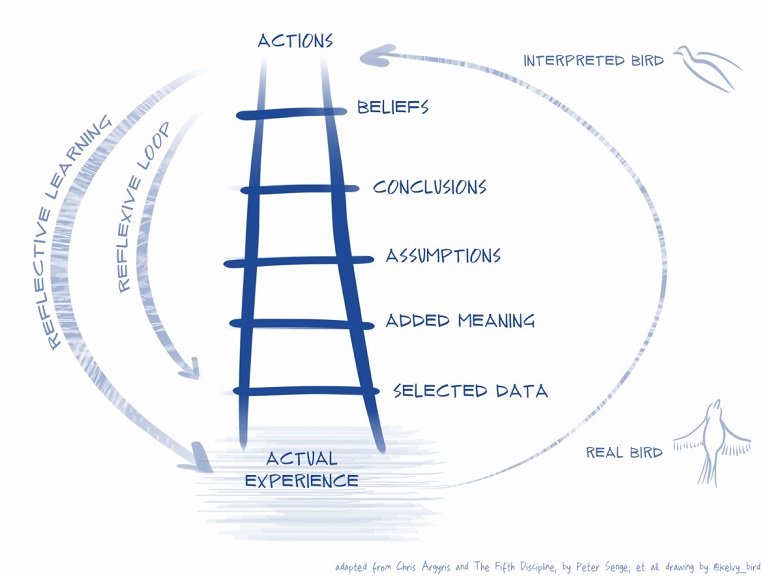
Chris Argyris developed the ladder of inference as a tool for double-loop learning – learning that produces a change in values and assumptions, not just behaviour change. The ladder of inference can be used for different purposes: to reflect on your emotional reactions, to facilitate the discussion of substantive issues, and to give people feedback. It provides a guide for effective advocacy and inquiry and sits comfortably alongside Transactional Analysis.
We live in a world of self-generating beliefs that remain largely untested. We adopt those beliefs because they are based on conclusions, which are inferred from what we observe, plus our past experiences.
Our ability to achieve the results we truly desire is eroded by our feelings that:
- Our beliefs are the truth
- The truth is obvious
- Our beliefs are based on real data
- The data we select are the real data
The key points for using the ladder of inference to promote productive conversation and effective action are:
- Be aware of your reasoning steps, publicly check your inferences, and encourage others to do the same
- Look for information that challenges your own and others’ assumptions and beliefs
- Be aware of how your own actions become information that others use to make inferences about you so that you can change
Helpful additional information
Watch a few short films.