
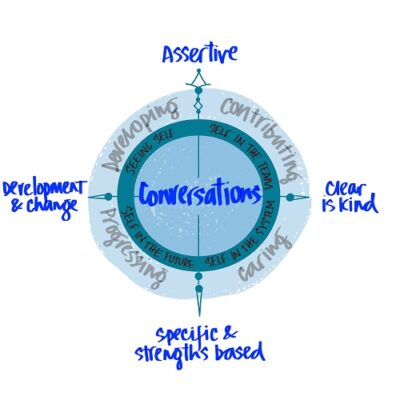
THE COMMUNICATION and CHANGE MODULE IN 3 SENTENCES
Communication as a core leadership behaviour is an awareness raising experience, understanding where and why you communicate in particular ways.
Communication as a core leadership behaviour is a journey of discovery into your helpful and unhelpful patterns of communication, especially in high stakes change situations.
Communication as a core leadership behaviour is an opportunity to engage in coming out from behind the conversations you have been avoiding and connecting with a philosophy of ‘clear is kind’.
LEARNING INTENTIONS FOR THIS MODULE
Introduce the idea of Change as a Transition.
Reflect on significant learning from thinking around the ‘Fierce Conversations’ framework and relate this to a changing operating environment.
Connect to the guiding principles of Adult-to-Adult assertive conversations and how these can be used to promote change.
Prepare and practice using opening statements assertively.
Explore Theory U as a change framework for teams.
UNDERPINNING THEORY
Transactional Analysis: Eric Berne.
Fierce Conversations: Susan Scott.
Thinking Environments: Nancy Kline.
How Full is Your Bucket: Clifton and Rath.
Transitions: William Bridges.
Theory U: Scharmer et al.
IMPORTANT CONVERSATIONS
We get what we tolerate. This is true in all our life relationships, from families of origin to work teams and to social friendships.
What we do away from work is of course our choice, however, if at work we have a responsibility to lead, then the choice about what we tolerate – or more likely just don’t challenge has an impact on leadership impact, team cohesion and organisational culture. Often, we give ourselves permission to not have the conversations we need to have because we are afraid of the emotional and personal consequences.
In her book “Fierce conversations”, Susan Scott outline 7 principles to enable tackling your toughest challenges and enriching relationships with everyone important to your success and happiness. These 7 principles are:
1. Master the courage to interrogate reality
At first glance, it seems like a nonsensical thing to do. Reality just is, it needn’t be interrogated. We live in the present and the spread of the internet has rendered all of us more informed than ever before. Right? Well, not so much. We connect with the people who are similar to us, we follow blogs and channels that interest us and say what we want to hear. Most people live in their own bubble and are not really aware of when and how things change. Or how other people change, for that matter. Getting out of the comfort zone and probing how things truly stand is highly necessary.
2. Come out from behind yourself, into the conversation, and make it real
Susan Scott says that it is not the genuine conversations we should dread but the unreal ones – they may not be uncomfortable while they are happening but in the long run, they are the ones that are detrimental. Talking just for the sake of talking does not solve anything and in the end, proves to run rather expensive both for the individual and for the organization. When it’s paramount for things or people to change in order to get out of a situation or to simply make some progress, a real conversation is key. It will lead to transformation before it is even over.
3. Be here, prepared to be nowhere else
A difficult conversation requires a true presence. There is a lot of value placed these days on a thing called “mindfulness”. It’s the art (or skill) of being in the moment and dealing with it as it happens instead of wondering what could have gone differently in the past or projecting what the future will look like. It’s not guaranteed that an organization or an individual will change because of one discussion but it’s not impossible either. A hard talk has to be planned and carried out with the utmost attention and participation. Otherwise, it won’t count.
4. Tackle your toughest challenge today
We all tend to avoid or postpone things that make us uncomfortable. While that is natural, it is also counterproductive because we end up carrying around a burden or worry a lot longer than it would be necessary. Once the problem is named it is almost solved. Figuring out what the greatest issue is and dealing with it on the spot instead of floating it to undefinable times will ensure a much smoother path. Getting rid of the daunting agenda and staying current with those who are really important will bring a better vibe and a greater chance of success.
5. Obey your instincts
Our instincts are responsible for our survival and evolution. They come from the oldest part of our brain and to this day are responsible for all decision making. The limbic brain, however, does not have the capacity for language, so most of the time when we do or don’t do something we can’t really explain our reasons and resort to “it’s just a gut feeling”. In difficult conversations, it’s important to not only trust but actually go with instincts. It’s yet another way of being present, aware, and (though it doesn’t seem like for lack of worded arguments) in control.
6. Take responsibility for your emotional wake
This principle is my personal favorite because as a trainer I have often had to deliver feedback that was not necessarily great. For a long time, the company requirement was that I do so in a “sandwich manner” – say something positive, give the ‘constructive’ criticism, and end with something even more positive. There was a great fear of hurting feelings or giving wrong impressions, but that’s precisely what happened. A genuine message has to be delivered without this kind of negative load. One of the most powerful insights of this book is that the conversation is not about the relationship; the conversation is the relationship.
7. Let silence do the heavy lifting
When there is too much talk in a conversation, ideas are very likely to be lost between words. Just as motivational speakers know that pauses are needed in order for things to sink in and reach the cords they were meant to, fierce conversations need silence as well. Insight occurs in the spaces between the words being spoken. Memorable talks have breathing time and allow for inner dialogue. That’s where a-ha moments happen and that is how true change occurs.
Conclusion
I find there is no better conclusion to this model than the one of the author’s herself: “We must answer the big questions in our organizations. What are the questions that need posing? Philosophers, theologians, scientists, and great teachers have debated this for ages:
What is real?
What is honest?
What is quality?
What has value?
We effect change by engaging in robust conversations with ourselves, our colleagues, our customers, our family, the world. Whether you are governing a country, running an organization, or participating in a committed personal relationship, your ability to effect change will increase as you become more responsive to your world and to the individuals who are central to your happiness and success…”
Assertiveness and Important Conversations
Assertiveness is one of the single most effective characteristics you can acquire in your working life. You are more likely to get what you want in half the time and without treading on everyone’s toes in the process.
Assertive behaviour is the ability to communicate your own thoughts and wishes in a clear, direct and non-aggressive way. It’s about knowing where you stand and communicating from this starting point.
With life’s experiences and knocks, we pick up all sorts of behaviour patterns – good and bad – that make us who we are. We end up assuming bad traits are part of our true self when in fact they’re not. Just as it’s not good to be aggressive, it’s not good to let people take advantage of you. The answer in an age where people are increasingly resorting to bullying is to be assertive. This is directly related to the work we have done on Transactional Analysis earlier in the programme.
Being more assertive will raise your self-esteem and give you the confidence to resist bully tactics and emotional blackmail without resorting to aggression. People who develop good communication skills are able to diffuse difficult situations. Naturally, this will help in your personal relationships too. Far from being more difficult to deal with, being assertive will make you easier to deal with, because people will know where they stand with you. Assertive behaviour also promotes a positive response in others.
Here are the positive ways that assertiveness is beneficial – both to yourself and those who come into contact with you:
- You are taking control of both your life and its individual activities
- Others respect you – and you have a high level of self-respect
- It allows and encourages others to respond assertively to you
- You demonstrate the respect you have for others
- There’s less likelihood of conflict, anger or aggression being a disruptive factor in your life
- You develop a high level of self-esteem: your aim is to live up to the standards you set for yourself rather than trying to guess and work to other people’s expectations of you
- You allow other people to be in control of their lives. You give them room to manoeuvre in awkward situations
Bestselling author Susan Scott has been working as a leadership development architect for more than two decades. She is the founder of Fierce, Inc., a global training company that helps Global 1000 companies generate significant results by transforming the conversations central to their success. Listen to her talk about her concept of ‘Fierce Conversations’.
Align what you have discovered and where your thinking has taken you to the work on Transactional Analysis: what patterns are emerging about how you engage with challenging and important conversations?
FEEDBACK CONVERSATIONS
Getting others to accept our feedback can prove challenging, especially when it’s critical. Worried that their feedback may lead to feelings or diminished performance, managers resort to face-saving techniques like the “praise sandwich” that end up doing more harm than good. The result is a tenuous feedback culture built largely upon evasion, confusion, and self-delusion.
This dynamic can change with a better message — and a bolder mindset. Based on my work with leadership teams, I’ve found that when performance conversations are powered by partnership, the landscape shifts. Not only do managers enjoy better relationships with their teams, but their feedback may even produce greater joy, not fear.
Rather than relying on a feedback hierarchy, managers should consider a partnership model that distributes power and increases two-way conversation with their employees — leading to a more authentic and revealing feedback experience that fosters trust, flows with the rhythm of work, and sets the conditions for positive, lasting change. It’s a humbler approach to managing people that focuses on asking questions, not giving orders. I call it the difference between “window gazing” and “mirror holding.”
Read these digital downloads to learn more.