

Overview
We have developed an expanded toolkit to support you in embedding strengths-based conversations with others. This toolkit will walk you through the thinking, reference frameworks, the tools, and provide support on how to facilitate conversations and positive change irrespective of the start point.
The tools can be used in any order. We suggest that you think about the outcome you want to achieve, where the person/people are on their journey and you own level of confidence. If it’s a group conversation, it’s always good to get a colleague that has been thorough the Personal Leadership Programme to support you. All of the tools work online as well as in person. Our only advice would be, where you can, get in a room with people, this is especially important if you are using the tools as part of onboarding or a performance/growth conversation. Some colleagues have discovered that issuing ‘How Full is Your Bucket’ and having people complete the strengths profile is a good gateway to this thinking, but for others it is obvious to start with Personal Values. You will know what is right and that will be different in different situations.
The following is an inventory of the tools with guidance.
Please work your way through everything in SECTION ONE before you start as this provides the underpinning thinking for everything else.
As always if we can help, please don’t hesitate to reach out.
SECTION 1: PROCESS
TIME
Use existing pockets of time that you get together with the team/team members to have these conversations. Ideally you have a Conversations Roadmap for your team for 12months. This Roadmap could include team meetings, team briefings, team days, regular 1-2-1s, performance reviews and development conversations. It becomes an inherent part of operational reality and not something that is deprioritised in times of high stakes delivery.
Listen to Fiona talking about the importance of creating Thinking Environments and the role of the Facilitator as a Thinking Partner.
Detailed outlines are available for all these conversation starters.
All of the tools described and the supporting documents are available as downloads under the description.
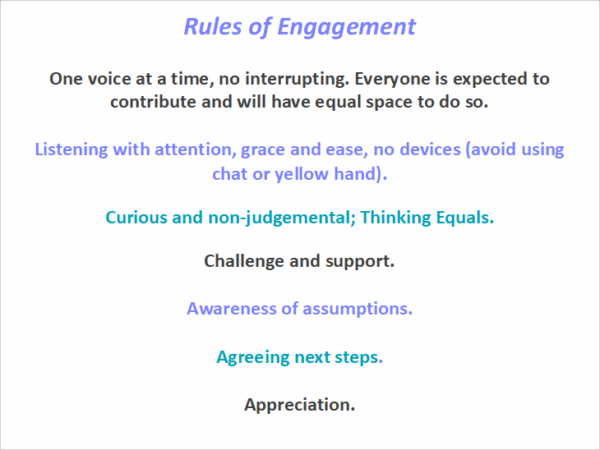
RULES OF ENGAGEMENT
After you have the time agreed and you are clear on what the conversation is focusing on and what tools/frameworks you are using, the next step is setting the Rules of Engagement. These work in all situations, online, in person, 1-1 and with groups. You have all experienced this way of working on the programme with myself and the team. We have discovered that these Rules of Engagement are game changing in terms of engagement and progression.
In a group situation you give everyone a turn to speak, we often say, ‘Who would like to go first?’ and then “Who would like to go next?’ or you simply say where you will start and finish.
If it’s 1-1 it is still important to do this and explain that you will be in a listening role. Here’s a form of words as a starter.
- Before we begin it can be helpful to confirm that my role is to help you to do your best thinking, I will not interrupt you or verbally respond to your thinking.
- It would be helpful for me if we can agree how you will let me know that one wave of thinking is complete, for example, ‘That’s everything for now.’.
- Only when I am sure that you are ready will I ask you another question. That may be the same question I have already asked, or it may not.
- Either way my only desire is to help you to discover your best thinking.
ROLE OF THE LEADER/FACILITATOR IN THESE CONVERSATIONS
Nancy Kline who developed the concept of Thinking Environments, describes the role of the person supporting the thinking, as being both essential and irrelevant. In a world where leaders are expected to come up with the answers, this is a different kind of conversation where you use inquiry and deep listening to create space for others to think.
Your fundamental role is to help others to think better for themselves. These conversations do not have a right and a wrong answer, only an energy towards self-awareness, change and positive outcomes, owned by the individual or the team.
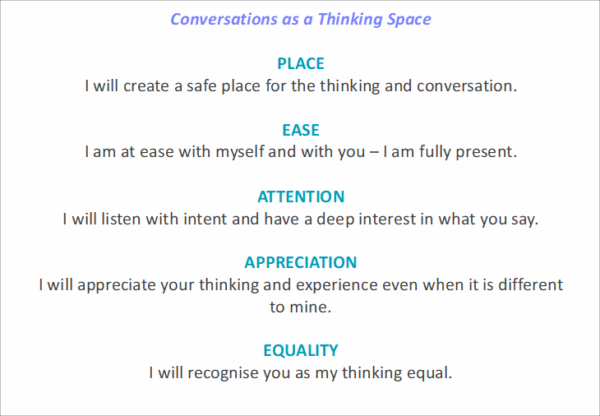
You do this by:
- Listening deeply and inquiring with genuine curiosity.
- Surfacing connectedness based on listening, genuineness and not knowing.
- Assuming that positive team and personal relationships are critical to business success.
- Giving structure to the emotional dimension of the work and the workplace.
- Supporting the Thinker to make decisions around assumptions.
- Supporting the Thinker to surface doubts and commitments, moving the thinking, decisions, and action forward.
- Encouraging directness, authenticity, and personal accountability.
- Giving permission for silence and then not filling it!
- Avoiding advice; it’s not about you. Your job is to help the other person/people think better for themselves.
POWERFUL QUESTIONS FOR CONVERSATIONS

To get deep thinking below the horizon we need to ask the questions that are powerful. Thinking about which questions we want to ask in advance and planning the space for responses is at the heart of this way of inquiring.
The scope of the question is the membrane or the boundary within which the responses can be made. If the question is about eliciting stories of strengths at work in a particular team, then that needs to be explicit in the question. All roads lead back to the question because you get what you ask about.
ASSUMPTIONS
All questions hold assumptions and the language that we use has a huge impact. The difference with Powerful Questions is that they are designed explicitly with a positive assumption. They assume there is a positive story to be shared, an idea to be explored or a decision that can be agreed. So “Why does it matter to you?” assumes that it does matter, “What if you could turn this situation around?” assumes that you can and “What would you do now if you had no fear?” assumes that you have ideas that could be valuable.
USING POWERFUL QUESTIONS
Powerful Questions are helpful in almost any situation. We encourage you to try them anywhere and everywhere. If you are faced with silence and a puzzled expression, then you are on the way. You will need to manage silence, wait with interest, and listen with appreciation and ease. On no account interrupt or disagree. Just listen and learn and then ask, “What more do you think or feel or want to say?”
CONSTRUCTING POWERFUL QUESTIONS
The checklist that follows is a useful way of checking whether the question you have is powerful enough. It takes time and practice because we are not used to preparing questions in this way. It is worth it and the knowledge you will gain as a leader is invaluable.
- What question, if explored thoroughly, could provide the breakthrough possibilities we are seeking?
- Is the question relevant to the real life or real work of the people who will be exploring it?
- Is this a genuine question; a question to which I/we really don’t know the answer?
- What work do I want this question to do? That is, what kind of conversation, meanings and feelings do I imagine this question will evoke in those who will be exploring it?
- What assumptions or beliefs are embedded in the way this question is constructed?
- Is this question likely to generate hope, imagination, engagement, new thinking, and creative action, or is it likely to increase a focus on past problems and obstacles?
- Does this question leave room for new and different questions to be raised as the initial question is explored?
All of the tools that follow use Powerful Questions in one form or another. They all come from a belief that people can think for themselves and that the role of the Facilitator/Leader/Thinking Partner is to listen well, be fully present and be genuinely interested.
SECTION 2: TOOLS FOR SELF REFLECTION
VALUES: An introduction to surfacing Personal Values and connecting them to behaviours. See this section.
This includes reflective practice against the 6 Universal Behaviours agreed in July 2025.
COMMUNICATION PREFERENCES & TRANSACTIONAL ANALYSIS: An introduction to Transactional Analysis, supporting the understanding of personal communication preferences and the impact on others. See this section.
APPRECIATIVE INQUIRY CONVERSATIONS: An introduction to the philosophy of asking questions about what is working and what is possible. Coming at challenges from the other side of the revolving door. See this section.
WHAT’S WORKING GRIDS (WWG): An introduction to the framework and how to use it, including examples. See this section.
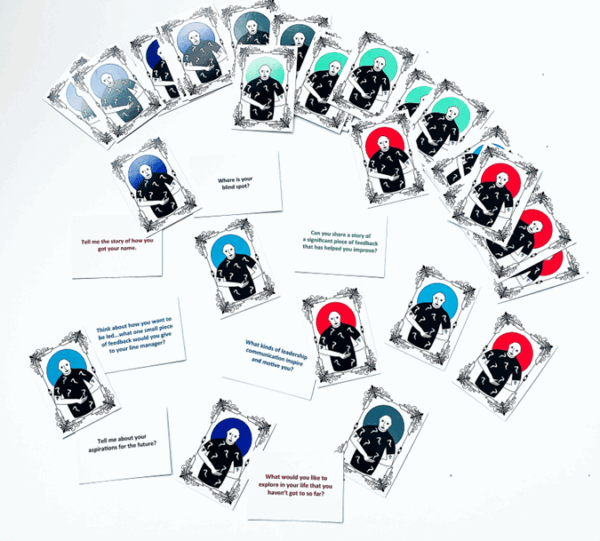
POWERFUL QUESTIONS CARDS: Fun ways of asking big questions, an easy way to put Appreciative Inquiry into practice. See this section.
VALUES CONVERSATION
The concept of personal values is both complex and simple. Complex because these values are likely to have started in our family of origin and have been developed by our life experiences and core beliefs. Simple because it is easy to see how values drive our behaviour.
The beliefs of parents and parental figures shape the early development of our values. These beliefs can be social, political, religious and moral and will be impacted by place, education and social standing. The subsequent values are likely to be how we approached the world and made judgements about good/bad, right and wrong, appropriate and not appropriate. These beliefs and values form our attitude and how we think about people, places and situations.
As we grow and develop, and are exposed to wider influences and experiences, our beliefs, values and attitudes change. As adults we have beliefs, values and attitudes that are developed independently of those of parents and parental figures, as well as those that we choose to keep from those early influences.
People care about values. Some care a lot and will actually decide who they work for and why based on the value proposition and how an organisation measures up to its professed values.
A 2018 survey by LinkedIn found that values are the number one priority for employees. Just under two thirds (71%) would take a pay cut to work for a company that has shared values and a mission they believe in and 39% would leave their current job if their employer asked them to do something that conflicted with their own morals or ethics. Almost half (47%) want to work in an environment where they can be themselves and have a positive effect on society (46%).
TIME
Make sure you plan the conversations in advance, explain why they are happening and affirm that there are no right and wrong response. 15 minutes to complete the survey. 30 minutes for a 1-1 conversation and 60 minutes for a small group conversation. You can use some of the Powerful question cards here too, just sift out the ones that you think would work.
THE PROCESS
NHSSC have created a Values Accumulator as part of the groundwork for a complete values refresh. You can work through the toolbox on values here.
In this toolbox, people can complete a values audit and also see the wider values across teams.
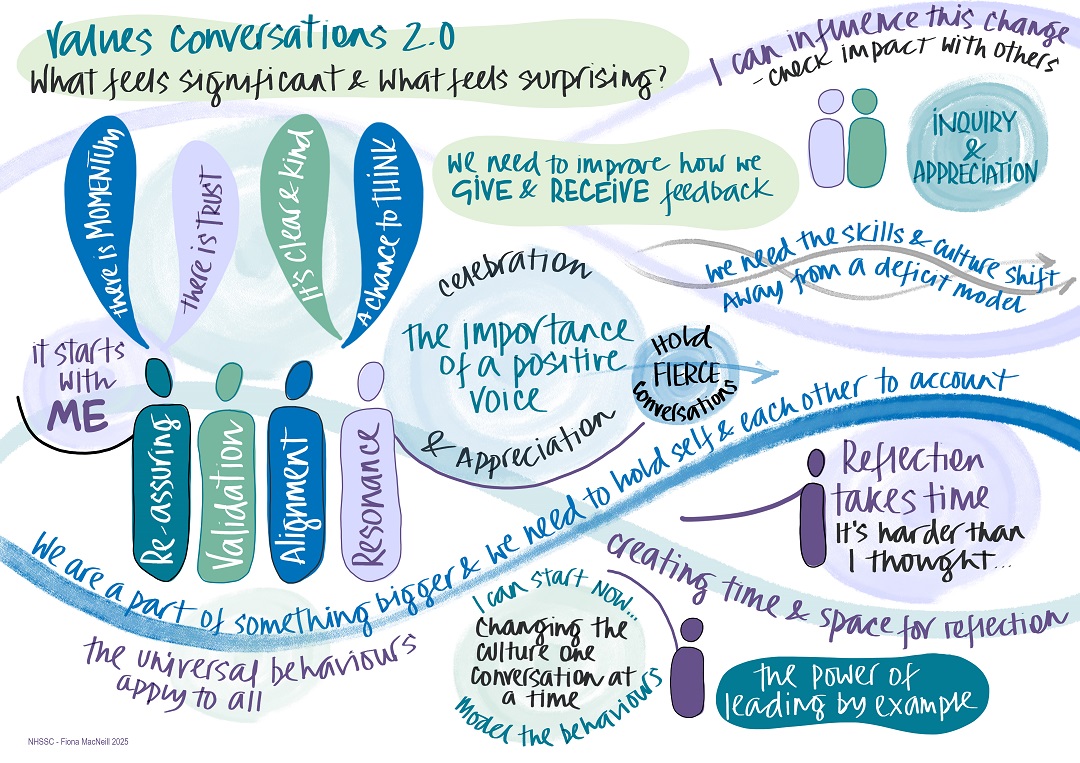
In July 2025, based on the information provided by over 800 people in the organisation, the universal values and behaviours were agreed.
In September 150, people attended a series of conversations which resulted in this graphic capture.
Listen to Fiona talking about values
To help people make the values and behaviours become real the following tools are available to download.
COMMUNICATION PREFERENCES
Listen to Fiona talking about Transactional Analysis
We all have communication preferences; these have been developed over time since we were small and have been impacted by parents and parental figures, our feelings and emotions and what we have learned as we have grown and developed.
Eric Berne created a framework that helps explain these patterns, when and where they are helpful and when and where they can get in the way for us.
Understanding our preferences and those of others can help us to respond rather than to react and to be considered about what and how we say things, especially in high stakes situations.
TIME
Make sure you plan the conversations in advance and explain why they are happening and that there are no right and wrong responses. 15 minutes to complete the self-assessment. 30 minutes for a 1-1 conversation and 60 minutes for a small group conversation.
THE PROCESS
- The opportunity for each person is in the first instance to crystallise their own communication preferences, using the tool TA 2025 in the Tools tab.
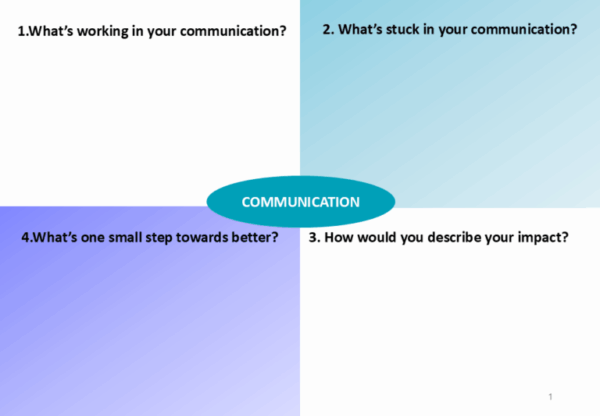
- There after you could use the Communication What’s Working Grid or just asked them to reflect on how they see their preferences show up at work, how do they help, how do they get in the way.
- If it is a group, then I suggest you use the Communication What’s Working Grid to enable conversations to take place from a similar start point.
- This could then be linked to a PDP.
APPRECIATIVE INQUIRY CONVERSATION
Appreciative Inquiry is a positive change framework. This works for 1-1 conversations and in groups of all sizes. If you want to plan a bigger Appreciative Inquiry, please reach out and we are happy to help you with that.
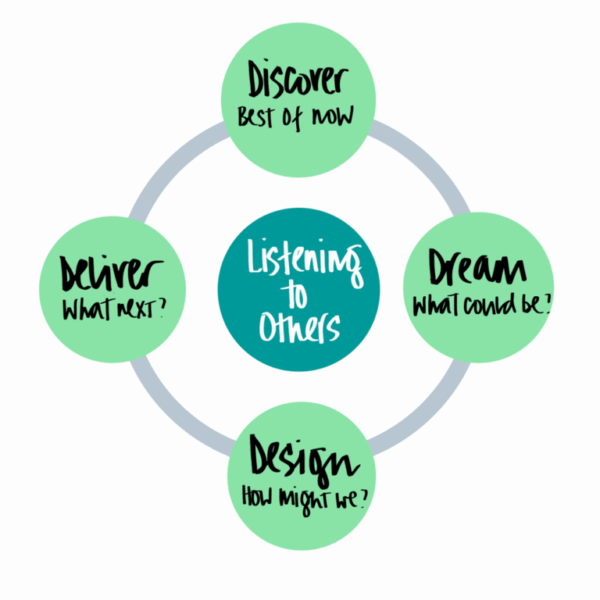
To enable easy application of Appreciative Inquiry, we use the 4D model. This guidance is for a 1-1 conversation.
TIME: 50 minutes – including setting up and getting feedback.
Ensure that the conversations are planned in advance.
GETTING TO THE QUESTIONS
When you are preparing to facilitate an Appreciative Inquiry or AI the critical starting point is around the area that you want to be better. Once you have agreed on that use the Powerful Questions Cards and the Handout on Powerful Questions to help you to form your Discovery questions, these are at the hear of your AI as they will encourage stories about what is working in the area you want to improve, what happens on the best day, where have they had experience of the topic working elsewhere, what were the conditions that enabled that etc. We are very happy to provide you with feedback on your questions before you get going.
THE PROCESS
- Everything in the earlier sections around creating Thinking Space (page 5) applies here.
- 5 minutes to set the scene, thanking them for taking the time and committing to follow up in 8 weeks to see how they have got on.
- I think 10 minutes for each of the 4Ds.
- 5 minutes to ask for feedback and offer appreciation.
- The questions offered are a guide only, there are lots of questions in the Powerful Questions section of this guide and also on the cards that work too.
- Whilst some of these questions are about strengths, they can speak about this in the abstract and not directly connected to their Gallup profile.
- No need to make notes in fact I would advise against it, just be fully present and curious.
QUESTIONS – DISCOVERY – The best of now and the recent past; unlocking stories.
These questions are story orientated. The responses don’t need to be work based.
Tell me about a time in the last 4 weeks when you were able to make a real difference?
And what more, would you say about what it felt like to make a difference?
QUESTIONS – DREAMING – What could be: visions of possibility.
These questions are future orientated.
Connecting to what you said about making a difference, what would it be like if you could do that more in other parts of your role/life?
How would that impact your motivation?
What if that kind of feeling was prevalent across the team?
QUESTIONS – DESIGN – Ideas for change.
These questions are idea orientated and take the thinking forward.
What ideas do you have about what we’ve talked about?
What do you need from me?
QUESTIONS – DESTINY/DELIVER – Actions.
These questions are action orientated and take the thinking forward.
What’s the first step and how will you know if it’s working?
What do you need from me?
INTRODUCING THE WHAT’S WORKING GRID (WWG)
The WWG is a practical tool based on the Appreciative Inquiry theory about building on what’s working to navigate next steps. A variety of WWGs are available as pptx slides, and we have provided an ‘empty’ grid for you to use for topics that matter to you and your team/stakeholders etc.
TIME
Ensure that the conversations are planned in advance. I would be tempted to start with people where you have a good relationship and remember to explain why you are having conversations in a different kind of way.
THE PROCESS
- This works well on a 1-1 basis and in groups, the latter coupled with the 1,2,4 framework.
- Use one of the provided WWG or decide what you want to explore and put that topic/project/behaviour in the centre of the WWG.
- Give the person or people the WWG at least 1 week in advance of the conversation.
- If it’s a 1-1, 30-60 minutes depending on the topic. Where you are also completing the WWG as well as the person it prior to the conversation (Strengths/Performance/Feedback) will need a bit longer.
- If it’s a group (3-12) then a minimum of 60 minutes.
- If it is a generic WWG about a project, change or collective strengths, then you can put people into pairs to complete a composite grid and then put 2 pairs together to produce a final composite.
- This really crystallises thinking and you can take the final grids away and summarise those and next steps.
- Around 20 minutes to complete for self (or in advance), 15 minutes in a pair and 20 minutes in the four.
- The key as with all these conversation starters they need to be real things that are being spoken about, and you need to follow up with next steps within 5 working days.
Downloads
INTRODUCING THE POWERFUL QUESTIONS CARDS
On the Personal Leadership Programme, delegates were introduced to the idea of Powerful Questions. Each leader was given a pack of Powerful Question cards. These cards way of them uncovering thinking and feeling that may not have been obvious to you or to the people taking part previously.
If you require additional packs of cards these are available at £35 please contact Fiona on [email protected].
TIME: 30 minutes (1-1 or 60 minutes in a small group)– including setting up and getting feedback.
Ensure that the conversations are planned in advance, you could ask for volunteers from the team, however if you do it this way it is important to try it with a mix of people and not just the usual suspects that volunteer for everything. I also think it’s a great process with a small team so no more than 10, or in small groups of 4 which might feel safer. Ideally you have a call explaining it. On no account should this just be an email.
I think you try it face to face first. It does work online too.
PROCESS FOR BOTH 1-1 AND GROUP
- Everything in the earlier sections around creating Thinking Space (page 5) applies here.
- 5 minutes to set the scene, thanking them for taking the time.
- Ideally you try both ways; 1-1 and a small group with different people.
1-1 CONVERSATIONS
- Cards are spread out on the table face up, questions not showing.
- Ask the person to pick any card and ask you the question. Answer as fully and openly as you can.
- Next reverse the process. You can always ask them the additional ‘what more would you like to think or feel or want to say’.
- Swap again this time ask them to ask you what more question after your initial responses.
- Swap again, this time give the person the opportunity to choose a card by looking at the questions. Respond to the question as fully and openly as possible.
- Repeat with you asking them a card you have chosen.
- Ask the person how they felt about the process and where it could be used in the wider team.
- Finally offer them some appreciation for getting involved and let them know you will feedback the results.
SMALL GROUP
- Cards are spread out on the table face up, questions not showing.
- Ask the first person to pick any card, read out the question and respond to the question as fully and openly as they can.
- If the question is too personal, they can put it back and choose another (not over and over).
- After each person you can come in with the ‘what more’ question. The easiest way to do this is to add it to the question for example…so Fiona what more would you like to say about.
- Next person does the same and so on until everyone including you has responded to one question.
- Depending on time and numbers, you could divide them into two smaller groups and they have another round.
- Ask the group how they felt about the process and where it could be used in the wider team.
- Finally offer them some appreciation for getting involved and let them know you will feedback the results.
SECTION 3: STRENGTHS CONVERSATIONS
Listen to Andy talking about strengths in a personal and organisational context
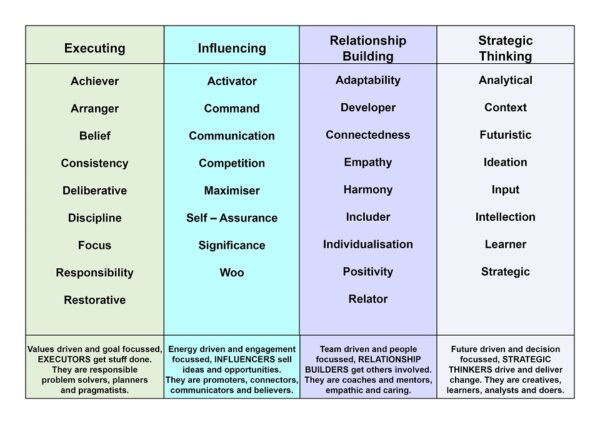
Gallup Strengths, also known as Clifton Strengths Finder, are 34 talent themes identified by an online assessment that uncover an individual’s natural patterns of thought, feeling, and behaviour. These are categorised into four domains: Executing, Influencing, Relationship Building, and Strategic Thinking. The assessment helps people understand their innate abilities to develop their greatest talents into strengths for professional and personal growth.
What the assessment does:
Identifies natural talents
The assessment identifies your top talent themes based on your answers to paired statements about yourself. Talent is defined as a naturally recurring pattern of thought, feeling, or behaviour that can be productively applied.
Focuses on strengths
Unlike traditional assessments that focus on weaknesses, Gallup Strengths emphasizes your natural abilities, with the goal of using them to achieve greater success.
Offers actionable insights
The results help you understand what you naturally do best and how to develop your greatest talents into strengths, providing a roadmap for accomplishments in your career and personal life.
For you to work effectively through this section of tools the people you are working with will need to have completed the above assessment. We recommend the book “how Full is your Bucket’ by Tom Rath which has the assessment at the back. You will need a new hardbacked anniversary addition, as not all editions have the assessment. This is available on Amazon/Wordery etc.
INTRODUCING STRENGTHS
This is directly related to the person/people taking part in these conversations, having read ‘How Full is Your Bucket’ and completed the strengths assessment. Not all editions of the book have the assessment. You need a new hardbacked Expanded Anniversary Edition.
Once the book has been read and the assessment completed you could facilitate this as a team introduction or a series of 1-1s.
TIME: 60 minutes (1-1) or 120 minutes (small group) – including setting up and getting feedback.
Ensure that the conversations are planned in advance, you could ask for volunteers from the team, however you do it this is important to try it with a mix of people and not just the usual suspects that volunteer for everything. I also think it’s a great process with a small team so no more than 10, or in small groups of 4- might feel safer. Ideally you have a call explaining it. On no account should this just be an email.
PROCESS FOR BOTH 1-1 AND GROUP
- Everything in the earlier sections around creating Thinking Space (Page 5) applies here.
- 5 minutes to set the scene, thanking them for taking the time.
- No need to take notes, just be fully present.
POWERFUL QUESTIONS FOR 1-1 STRENGTHS CONVERSATIONS
- What was significant and surprising for you when you read the book?
- How did it feel when you discovered your strengths?
- Tell me about what your top 5 strengths mean to you in your role?
- How do you see your top 5 strengths showing up away from work?
- How might you use your strengths more and how can I help?
- What would it be like for you if the Touchpoints were Strengths Based both for what’s working and what needs to change?
SMALL GROUP PRESENTATION
The purpose of this presentation is to provide guidance for leaders who have line management responsibility to introduce the concept of strengths-based leadership and teams to their people. The session is 120 minutes and should be delivered to groups no larger than 10.
This will work equally well in person and online. Everything around creating the conditions that you have read earlier applies here. Where possible I think it is helpful to do this in pairs where one of you can gather themes and feedback and manage the breakout rooms.
STRENGTHS WHAT’S WORKING GRID
This document is designed to support people to get the best from their Clifton Strengths Finder Profile. The suggestion is that people complete the girds associated with their top five Strengths and read this along with their report from Gallup.
Importantly this is about thinking in detail about actual examples where they can identify where they are playing ‘unconsciously to their strengths’ and also where the ‘shadow side of their strengths’ gets in the way.
To help this to be an easy process we have provided a four-box grid called ‘What’s Working Grid’ or WWG for short. Whilst there is no right and wrong way of doing things, we know an example usually helps. Below you can see an example for one of my top five strengths: STRATEGIC from the STRATEGIC THINKING DOMAIN.
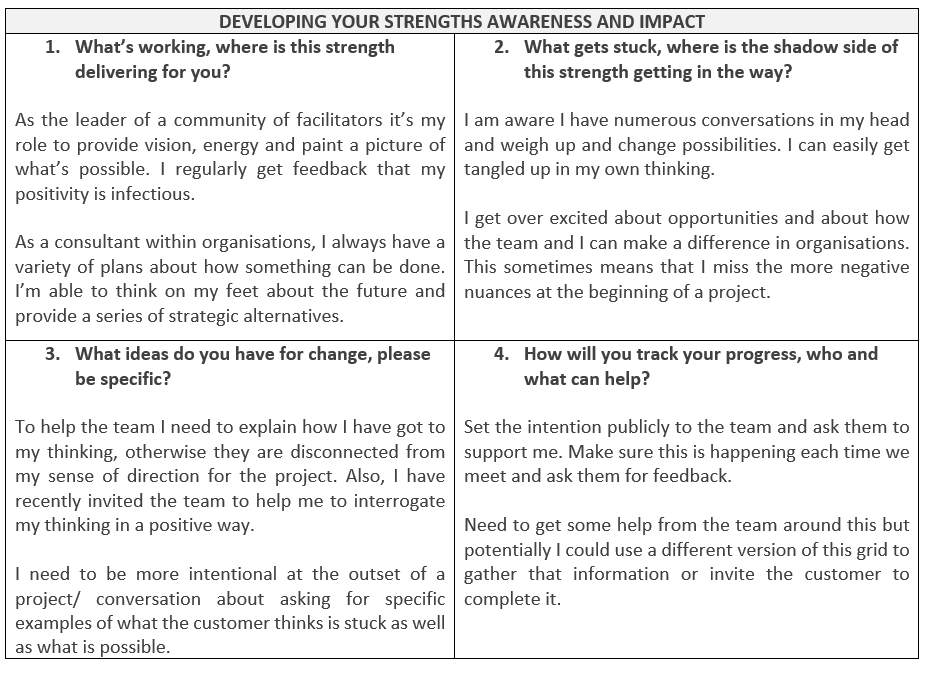
In the spirit of transparency, vulnerability, and trust building, I suggest that you complete the grid for one of your strengths and give that to your people before you ask them to complete this activity.
Thereafter have the conversation around what has emerged for people around the activity. I think around an hour to have a 1-1 on the 5 strengths.
TEAM DEVELOPMENT SESSION
To make the best use of the next set of tools you need to have completed the INTRODUCTION TO STRENGTHS session and asked them to complete the Strengths Development Map.
The Strengths Based Development Map is built around the Appreciative Inquiry model. It is a record of a conversation between a person talking about their strengths and the person facilitating the conversation, this may or may not be a line manager. The suggestion is that the team member comes to the conversation with their map completed in draft and the person facilitating the conversation has the role of helping them to take their thinking further.
The overall conversation is likely to be about 60minutes and should be held by reflective questions and listening. Everything about the rules of engagement apply here.
Your job as the facilitator is to dig into what they have prepared and shared, using powerful questions to support them to dig into their thinking and commitment.
Think about the time before you start. As a guide:
- 5-10 minutes to settle in; what have they been thinking about since you last met?
- 15 minutes of the experience of the WWG; how did they find the experience, what has changed about their understanding of their strengths as a result, so what will they do with that knowledge now?
- 25 minutes on the development map; how did they find the experience, what has changed about their understanding of what they need to do with their strengths now, who can help them, how will they get feedback? Suggest they share their thinking with their line manager at the next Touch Point meeting.
- 5 minutes to thank them and close appropriately.
GUIDANCE FOR THE INDIVIDUAL
This Strengths Development Map gives you a different way to start thinking about your contribution to yourself, the team, and the work. The idea is that you print this on A3 paper, although it is also available in a table format if that is your preference. The Strengths Development Map is read alongside your reflections using the WWG for your top 5 strengths.
Arrive at the conversation with your completed WWG and a draft of your thoughts on the Strengths Development Map. After you have the conversation, we suggest you share the thinking the next time you are with your line manager at a 1-1.
They have guidance on how to have these conversations with you.
SECTION 4: TOOLS FOR WIDER CHANGE
MAP OF INFLUENCE: A creative way for teams or individuals to map influence, notice blind spots and ask for feedback. See this section
PUSH-ME/PULL-ME QUESTIONNAIRE: Identifying Influencing Styles and Preferences, especially fun in a team setting and connected up to TA and strengths. See this section.
FIERCE CONVERSATIONS: a practical framework to plan feedback conversations. See this section.
MAP OF INFLUENCE and PUSH ME PULL ME QUESTIONNAIRE
The video below is a great thought starter for this work
The example below is my map at a given time. Connecting this to Strengths can be very helpful and how you can use your strengths to Influence (See the handout Influencing with Strengths).
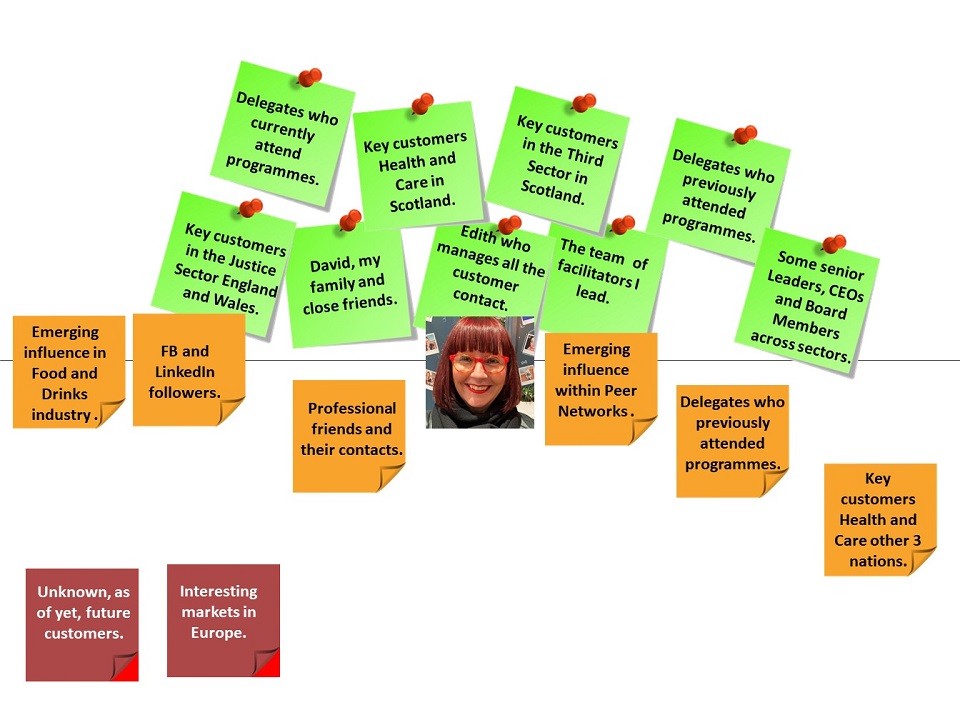
TIME: 60 minutes (1-1) or 120 minutes (small group) – including setting up and getting feedback.
Ensure that the conversations are planned in advance, you could connect this to a live project or to support the development of an individual. I think it’s a great process with a small team so no more than 10. Ideally you have a call explaining it. On no account should this just be an email.
I think you try to be face to face with people. It does work online but it’s not as effective.
PROCESS FOR BOTH 1-1 AND GROUP
- Send the person/people the information and image above and the Push Me Pull Me Questionnaire.
- Everything in the earlier sections around creating Thinking Space applies here.
- 5 minutes to set the scene, thanking them for taking the time.
- No need to take notes, just be fully present.
QUESTIONS THAT CAN SUPPORT THE CONVERSATION
- What have you discovered about your influence from completing the Push Me/Pull Me assessment?
- How does this link with your strengths and your Transactional Analysis?
- How can you use what you have learned to develop you Map of Influence?
- What do you need from me moving forward?
- If it’s a project, what are our collective actions moving forward?
FIERCE CONVERSATIONS
We get what we tolerate. This is true in all our life relationships, from families of origin to work teams and to social friendships.
What we do away from work is of course our choice, however, if at work we have a responsibility to lead, then the choice about what we tolerate – or more likely just don’t challenge has an impact on leadership impact, team cohesion and organisational culture. Often, we give ourselves permission to not have the conversations we need to have because we are afraid of the emotional and personal consequences.
In her book “Fierce conversations”, Susan Scott outline 7 principles to enable tackling your toughest challenges and enriching relationships with everyone important to your success and happiness. These 7 principles are:
1. Master the courage to interrogate reality
At first glance, it seems like a nonsensical thing to do. Reality just is, it needn’t be interrogated. We live in the present and the spread of the internet has rendered all of us more informed than ever before. Right? Well, not so much. We connect with the people who are similar to us, we follow blogs and channels that interest us and say what we want to hear. Most people live in their own bubble and are not really aware of when and how things change. Or how other people change, for that matter. Getting out of the comfort zone and probing how things truly stand is highly necessary.
2. Come out from behind yourself, into the conversation, and make it real
Susan Scott says that it is not the genuine conversations we should dread but the unreal ones – they may not be uncomfortable while they are happening but in the long run, they are the ones that are detrimental. Talking just for the sake of talking does not solve anything and in the end, proves to run rather expensive both for the individual and for the organization. When it’s paramount for things or people to change in order to get out of a situation or to simply make some progress, a real conversation is key. It will lead to transformation before it is even over.
3. Be here, prepared to be nowhere else
A difficult conversation requires a true presence. There is a lot of value placed these days on a thing called “mindfulness”. It’s the art (or skill) of being in the moment and dealing with it as it happens instead of wondering what could have gone differently in the past or projecting what the future will look like. It’s not guaranteed that an organization or an individual will change because of one discussion but it’s not impossible either. A hard talk has to be planned and carried out with the utmost attention and participation. Otherwise, it won’t count.
4. Tackle your toughest challenge today
We all tend to avoid or postpone things that make us uncomfortable. While that is natural, it is also counterproductive because we end up carrying around a burden or worry a lot longer than it would be necessary. Once the problem is named it is almost solved. Figuring out what the greatest issue is and dealing with it on the spot instead of floating it to undefinable times will ensure a much smoother path. Getting rid of the daunting agenda and staying current with those who are really important will bring a better vibe and a greater chance of success.
5. Obey your instincts
Our instincts are responsible for our survival and evolution. They come from the oldest part of our brain and to this day are responsible for all decision making. The limbic brain, however, does not have the capacity for language, so most of the time when we do or don’t do something we can’t really explain our reasons and resort to “it’s just a gut feeling”. In difficult conversations, it’s important to not only trust but actually go with instincts. It’s yet another way of being present, aware, and (though it doesn’t seem like for lack of worded arguments) in control.
6. Take responsibility for your emotional wake
This principle is my personal favorite because as a trainer I have often had to deliver feedback that was not necessarily great. For a long time, the company requirement was that I do so in a “sandwich manner” – say something positive, give the ‘constructive’ criticism, and end with something even more positive. There was a great fear of hurting feelings or giving wrong impressions, but that’s precisely what happened. A genuine message has to be delivered without this kind of negative load. One of the most powerful insights of this book is that the conversation is not about the relationship; the conversation is the relationship.
7. Let silence do the heavy lifting
When there is too much talk in a conversation, ideas are very likely to be lost between words. Just as motivational speakers know that pauses are needed in order for things to sink in and reach the cords they were meant to, fierce conversations need silence as well. Insight occurs in the spaces between the words being spoken. Memorable talks have breathing time and allow for inner dialogue. That’s where a-ha moments happen and that is how true change occurs.
Conclusion
I find there is no better conclusion to this model than the one of the author’s herself: “We must answer the big questions in our organizations. What are the questions that need posing? Philosophers, theologians, scientists, and great teachers have debated this for ages:
What is real?
What is honest?
What is quality?
What has value?
We effect change by engaging in robust conversations with ourselves, our colleagues, our customers, our family, the world. Whether you are governing a country, running an organization, or participating in a committed personal relationship, your ability to effect change will increase as you become more responsive to your world and to the individuals who are central to your happiness and success…”
Assertiveness and Important Conversations
Assertiveness is one of the single most effective characteristics you can acquire in your working life. You are more likely to get what you want in half the time and without treading on everyone’s toes in the process.
Assertive behaviour is the ability to communicate your own thoughts and wishes in a clear, direct and non-aggressive way. It’s about knowing where you stand and communicating from this starting point.
With life’s experiences and knocks, we pick up all sorts of behaviour patterns – good and bad – that make us who we are. We end up assuming bad traits are part of our true self when in fact they’re not. Just as it’s not good to be aggressive, it’s not good to let people take advantage of you. The answer in an age where people are increasingly resorting to bullying is to be assertive. This is directly related to the work we have done on Transactional Analysis earlier in the programme.
Being more assertive will raise your self-esteem and give you the confidence to resist bully tactics and emotional blackmail without resorting to aggression. People who develop good communication skills are able to diffuse difficult situations. Naturally, this will help in your personal relationships too. Far from being more difficult to deal with, being assertive will make you easier to deal with, because people will know where they stand with you. Assertive behaviour also promotes a positive response in others.
Here are the positive ways that assertiveness is beneficial – both to yourself and those who come into contact with you:
- You are taking control of both your life and its individual activities
- Others respect you – and you have a high level of self-respect
- It allows and encourages others to respond assertively to you
- You demonstrate the respect you have for others
- There’s less likelihood of conflict, anger or aggression being a disruptive factor in your life
- You develop a high level of self-esteem: your aim is to live up to the standards you set for yourself rather than trying to guess and work to other people’s expectations of you
- You allow other people to be in control of their lives. You give them room to manoeuvre in awkward situations
Bestselling author Susan Scott has been working as a leadership development architect for more than two decades. She is the founder of Fierce, Inc., a global training company that helps Global 1000 companies generate significant results by transforming the conversations central to their success. Listen to her talk about her concept of ‘Fierce Conversations’.
Align what you have discovered and where your thinking has taken you to the work on Transactional Analysis: what patterns are emerging about how you engage with challenging and important conversations?