
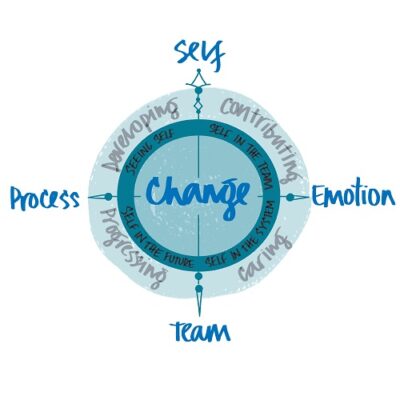
The leaders we work with often report feeling stuck, ill-equipped or overwhelmed as they face the growing challenges of their roles. Understandably, it’s easy to feel this way when the complexity of our world has surpassed our “complexity of mind,” as Robert Kegan and Lisa Lahey describe in their book, Immunity to Change. To put this in concrete terms, computing power has increased more than a trillion-fold since the mid-1950s, but our brains remain unchanged.
To effectively lead others in increasing complexity, leaders must first learn to lead themselves. Although each leader faces their own unique circumstances, we have observed six strategies that accelerate your ability to continually learn, evolve, and navigate progressively more complex challenges.
Everything that you have learned on the Personal Leadership part of the programme is helpful here.
Victoria Grady identifies 3 attitudes/behaviours that can help leaders lead others through change: Choice. Connection to Purpose and Bridge. Read her easy guide here:
Inner Change Journey
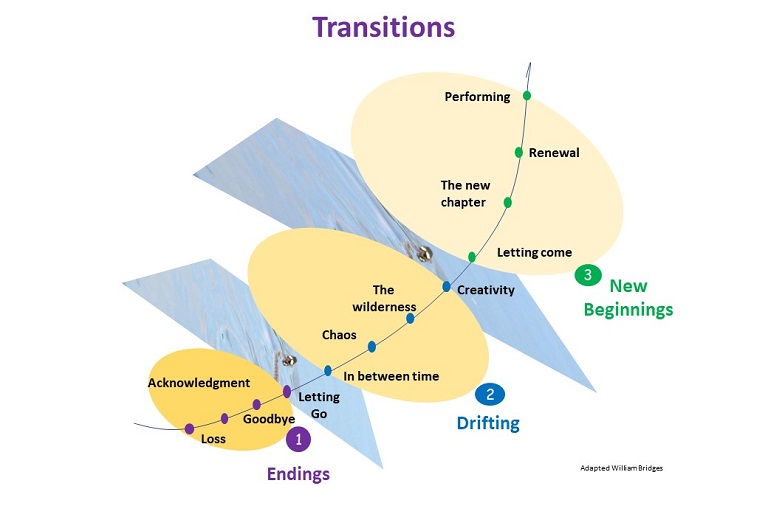
William Bridge’s transitions model is a powerful model used to understand the stages of personal transition and system change. It helps you to think about how people might respond to change. Experience, patterns of behaviour and current emotional state underpin how people will respond to change.
So, understanding the differences in behaviours and emotional responses can help leaders and change makers respond appropriately by looking to get the best from people. It’s important to remember that these are ‘normal’ and ‘natural’ responses to change, and it’s only the part of getting stuck in the unhelpful behaviour states that should be any cause for concern.
William Bridges spent his life helping people and organisations to ‘transition’ through change. The fundamentals of his thinking are laid out below.
Change is the external event or situation that takes place: a new business strategy, a turn of leadership, a merger or a new product. The organisation focuses on the desired outcome that the change will produce, which is generally in response to external events. Change can happen very quickly.
Transition is the inner psychological process that people go through as they internalise and come to terms with the new situation that the change brings about. Empathetic leaders recognise that change can put people in crisis. The starting point for dealing with transition is not the outcome but the endings that people have in leaving the old situation behind.
Change will only be successful if leaders and organisations address the transition that people experience during change. Supporting people through transition, rather than pushing forward, is essential if the change is to work as planned. This is key to capitalising on opportunities for innovation and creating organisational resilience.
From a systems perspective, it makes sense that the system is also transitioning. Endings may be traditional and conventional processes being changed, hierarchies being flattened, and budgets being reduced. Beginnings may be new ways of working, more enabling structures and a complete rethinking of how we do things around here.
Systems Change
‘Continuing to do what we are currently doing but doing it harder or smarter is not likely to produce very different outcomes. Real change starts with recognizing that we are part of the systems we seek to change. The fear and distrust we seek to remedy also exist within us – as do the anger, sorrow, doubt, and frustration. Our actions will not become more effective until we shift the nature of the awareness and thinking behind the actions.’
— Senge, Hamilton and Kania
Systems change is inherently an “inner” and “outer” process or journey. This work involves deep shifts in mental models, relationships, and taken-for-granted ways of operating as much as it involves shifts in organisational roles and formal structures, metrics and performance management, and goals and policies. Because of this, we believe that the development of self is foundational.
This inner work – which involves developing awareness, compassion, understanding, and wisdom – is part of what you have been working on in the early parts of the programme when you reflected on your Transactional Analysis, Strengths and the interview with your line manager. This section of the toolbox extends that thinking to how to create the conditions for successful systems change.
A Systems Focus: Theory U
Theory U is change philosophy and process co-created by Otto Scharmer and his colleagues at the Presencing Institute https://www.presencing.org and the Massachusetts Institute of Technology.
Building upon two decades of action research at MIT, the process shows how individuals, teams, organisations and large systems can build the essential leadership capacities needed to address the root causes of today’s social, environmental, and spiritual challenges. It differs from most change methodologies because it does not predetermine the endpoint.
It uses a human-centred approach to letting go of ego and embracing eco. This just means making it about the whole system and not just about you or your part of the system. This way of engaging with change considers disconnects and blind spots across the system as well as mining potential and opportunity.
Everything we are learning with Covid 19 is reinforcing just how critical this kind of approach is and what can happen when we forget about the wider, bigger impact.
The journey through the U requires leadership from everyone. Not just hierarchical leaders, everyone acting as a leader for the whole system.
This requires specific leadership behaviours, which Otto describes as 7 Leadership Capacities:
- Holding the Space of Listening: to self and to others, suspending judgment and the call to action
- Observing: looking with fresh eyes
- Sensing: seeing the system from the edges by seeking out the views and experiences you don’t have
- Presencing: connecting deeply to self and the system
- Crystallising: creating shared purpose, energy and intention
- Prototyping: manifesting all of the thinking, emotion and ideas visibly, testing change
- Co-evolving: a roadmap to scaling change and embedding new thinking and behaving
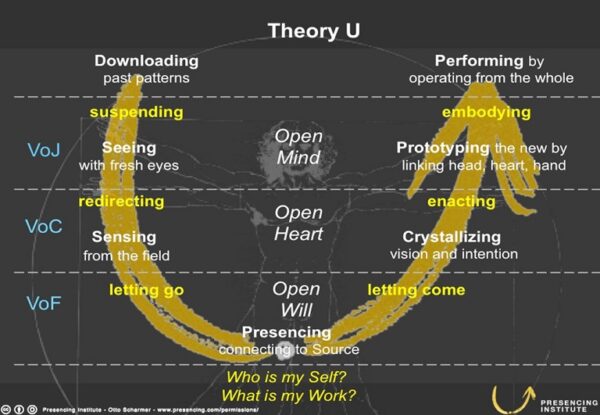
Watch a simple animated introduction to Theory U.