
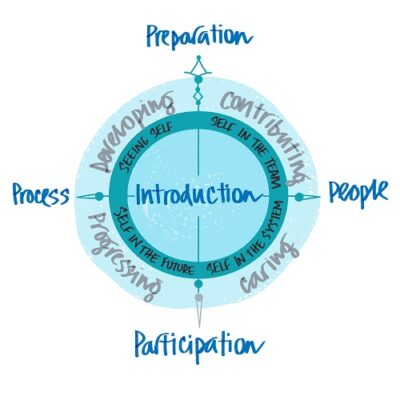
- Introducing Personal Leadership is developed to support your understanding of the underpinning purposes and processes of the programme.
- Introducing Personal Leadership will include self-study and reflection before arriving at the first workshop PERSONAL LEADERSHIP.
- Introducing Personal Leadership is an opportunity to settle yourself in the format to enable us to arrive prepared to convene as a learning group.
- Introducing the supporting text books.
MODULAR CONSTRUCT
This toolbox is structured around 5 core modules. Depending on your programme you may not be required to complete the work for every module:
- PERSONAL LEADERSHIP
- STRENGTHS
- COMMUNICATION AND CHANGE
- INFLUENCE
- CRYSTALLISING LEARNING
Each of these modules has its own ‘tab’ in this toolbox. There you will find all the pre-work, as well as downloads, videos, and other materials for future reference. We hope this makes it easy to follow and of course if you have any questions or concerns, please don’t hesitate to contact me by email: [email protected]
The programme is supported by two text books; How full is Your Bucket by Conche and Rath and Fierce Conversations by Susan Scott. These books will be issued to you at the first workshop and underpin a lot of the thinking and philosophy throughout the programme.
How Full is your Bucket is a quick and easy 90-minute read, Fierce Conversations will take longer. You need to read How Full is your Bucket before WS2, we suggest you start Fierce Conversations at the beginning of the programme. If you read 45 minutes a week from the day the programme starts, you will have completed the book by WS3.
The programme is also supported by a physical workbook which you will receive at WS1 and will guide you through the programme, connecting the toolbox to your thinking and application in practice. More on this later in the introduction.
THINKING PARTNERS
Having a Thinking Partner is a central part of the programme. You will be partnered with another leader from a different group. This person will not be in your function.
THINKING SPACE
This Personal Leadership Programme is built on the foundations of Thinking Space being created:
- by Fiona MacNeill for you and your colleagues
- by you for your Thinking Partner on the programme
- and most importantly by you for yourself
Thinking Space for individuals will:
- Encourage directness, authenticity and personal accountability to hold up the mirror
- Assume that positive relationships are critical to success
- Give structure to the emotional dimension of thinking and the impact on personal effectiveness
- Explore assumptions and clarify decisions that the individual wants to make now
- Surface doubts and concerns, blind spots and unintended consequences
- Create the thinking that leads to real development and change for the individual
Thinking Space is typified by:
- The thinker thinking for themselves. It’s for anyone who wants to create the space to think and think differently
- The thinking partner acting as a custodian, taking care of the thinking through attention, appreciation and ease. Our only objective is to help you to think better for yourself
- The use of a specific framework for inquiry – including the Appreciative Inquiry 4D model and patterns of questions based on the work of Nancy Kline – designed from theory applied in practice
Resources: Thinking Space
Below are two handouts. The first is an overview to the concepts of creating Thinking Space. The second is a guide to support you to be a Thinking Partner to another delegate on the programme. Pleased download and read the second resource before the first workshop.
Helpful additional information
Some fantastic clips of Nancy Kline speaking about what has inspired her work on Thinking Environments: https://www.timetothink.com/media/
PRE-WORK THOUGHOUT THE PROGRAMME
At each stage of the programme there will be around 6 hours of self-study which will include working though the content in this toolbox and having a conversation with your Thinking Partner who will be a fellow delegate. This allows the workshops to function as Thinking Spaces and for me to facilitate reflections, rather than present information.
In addition you will be issued with a Learning Grid which is unique to your programme and has all the dates, the hyperlinks and the references to the pages in the Workbook.
PRE-WORK FOR WORKSHOP 1: PERSONAL LEADERSHIP
- Read through everything and complete the associated tasks as you scroll down to the end of this section and this section.
- Please download your values report and your Transactional Analysis scores and bring them with you to the Workshop.
- Conversation with your Thinking Partner.
PRE-WORK FOR WORKSHOP 2: STRENGTHS
- Read through everything and complete the associated tasks in this section.
- Read the textbook ‘How Full is Your Bucket’ and complete the Strengths Assessment. This can be found at the back of the book via a unique access code to Gallup’s website.
- Click here to upload you Strengths to a Leadership Strengths Accumulator. This will eventually show the leadership strengths for the leaders in your team and across the organisation.
- Please download your strengths report and bring it with you to the Workshop.
- Have a conversation with your Thinking Partner.
PRE-WORK FOR WORKSHOP 3: COMMUNICATION and CHANGE
- Read and complete the associated tasks in this section and this section
- Introduce the idea of Change as a Transition.
- Reflect on significant learning from thinking around the ‘Fierce Conversations’ framework and relate this to a changing operating environment.
- Connect to the guiding principles of Adult-to-Adult assertive conversations and how these can be used to promote change.
- Prepare and practice using opening statements assertively.
- Explore Theory U as a change framework for teams.
PRE-WORK FOR WORKSHOP 4: INFLUENCE
- Read through everything and complete the associated tasks in this section.
- Create a Map of Influence and share this with your Line Manager and get feedback prior to the workshop.
PRE-WORK FOR WORKSHOP 5: CRYSTALLISING LEARNING
- Read through everything and complete the associated tasks in this section.
- Create your Leadership Compass, share with your team and get feedback prior to the workshop.
Rules of Engagement
INTRODUCTION
This section outlines how the team from Fiona MacNeill will facilitate across all components of the programme. This will be true whether this is a 1-1 conversation, conversations in small groups, or large group facilitation. These rules apply in online and in physical settings.
Our style and boundaries around facilitation and the expectations of behaviour, are one of the unique ways that we make a difference to people, teams and the wider organisation. These are core to our practice and non-negotiable.
Equally we understand that reasonable adjustments may need to be made, and these are also laid out below. As senior leaders who are the forefront of this culture change and development, it is paramount that you are modelling these behaviours in your interactions with your people away from the ‘development space’ as well as when you are part of it.
At the core of our belief is that we can support you to think better for yourself and help others to do so.
Independent thinking creates honest and accountable environments.
We cannot facilitate the change, only support you to do so.
FACILITATION STYLE
We will co-create with you an Adult-to-Adult learning and development environment, and this will provide a space where real practical learning can take place. This learning will include challenge and support, fun and creativity, individual and group activities, and a need to be fully present and engaged.
- The development is facilitated as a Thinking Environment – requiring respect, personal integrity and honesty. We will respect confidentiality taking account of the corporate goals of the programme and any perceived safe-guarding issue.
- A commitment to arrive on time and be prepared.
- One voice at a time, no interrupting, (when we interrupt, we interrupt thinking as well as speaking).
- Listen with attention, grace and ease, suspending voices of judgement, cynicism and fear.
- We are thinking equals; you can challenge the thinking of the facilitators and each other, and vice versa – the fundamental premise being that we help each other to think better for ourselves, not that we want to be right.
- We help each other to grow – we offer honest and detailed feedback about the impact of learning and behaviour. Importantly we appreciate what is good in what we see.
HOW DOES THIS LOOK IN PRACTICE?
- Tech free environment. If taking notes helps concentration and thinking, paper and pen is fine. This rule is about the quality of the attention we give to each other and is in place in both physical and online environments.
- Speaking without interruption. In an online environment we ask that the chat function and ‘yellow hand’ are not used as these are both a form of interrupting. We accept that we all have thinking preferences and to that end you will always have the learning intentions and processes prior to each intervention. You will always have time to think, before you are asked to speak. If you need information in other formats, please let us know.
- Curiosity. We will ask a lot of questions, some of these will be pre prepared but most will be in response to what we are experiencing from being with you. We will encourage you to think about the questions you need to explore, rather than defaulting to the ‘answers’ you have from current knowledge.
- Quality of attention. We invite you to be in the space and nowhere else. We equally appreciate that attention levels vary, and people may need breaks more frequently to enable them to remain present. To that end there will be a short space in each hour to get up and have a leg stretch as well as comfort and coffee breaks.