
Alex Elberg,
Executive Director Supply Chain
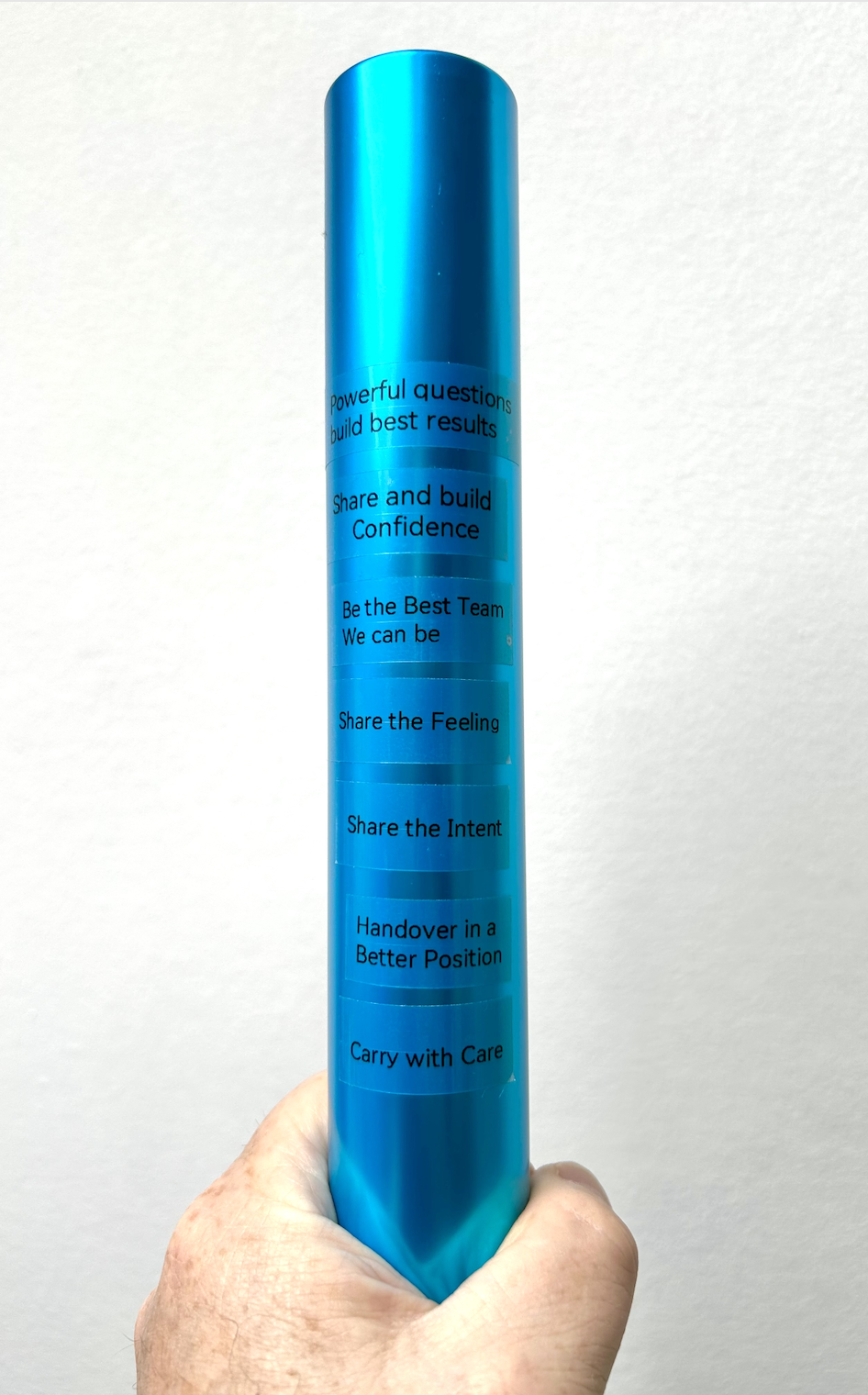
“Each phrase on my baton is a reminder of what’s important in my leadership.”
My Leadership Compass
On my desk sits a simple blue metal relay baton. It isn’t decorative, and it isn’t ceremonial. It is my leadership compass. For me a relay baton represents teamwork in its purest form. No one wins a relay alone. Success depends on accountability, trust, performance, and care. Leadership, I’ve learned, is much the same. We carry responsibility for a time, we move things forward, and then we pass it on, ideally leaving things in a better place than we found them.
Each phrase on my baton is a reminder of what’s important in my leadership.
Powerful Questions Build Best Results
Leadership is not about having the loudest voice or the quickest or smartest answer. It’s about asking the right questions.
Powerful questions challenge assumptions, surface risk, unlock creativity and opportunities, and invite others in. They turn problems into shared ownership rather than individual burden. When leaders ask well, teams think better, and the results follow.
Good leadership doesn’t say “Here’s the answer.”
It asks, “What are we missing?” and “What would good look like here?”
The Powerful Questions cards we were given on the course is also a fantastic tool to use to get to know your team and prompts the type of conversations that you would rarely have otherwise.
Share and Build Confidence
One of my Strengths came out as “Self-Assured”, but I believe that confidence isn’t something a leader hoards, it’s something they should give away.
By sharing information openly, trusting people with responsibility, and recognising effort as well as outcomes, leaders help confidence grow. When people feel trusted, they step up. When they are backed, they stretch further.
Confidence multiplies when leadership stops being about control and starts being about belief.
We have some ambitious plans ahead of us and it’s important that we all believe we will be able to make them happen, we have some amazing colleagues, so I believe we certainly can!
Be the Best Team We Can Be
Leadership success is never individual it’s collective.
Being the best team we can be means valuing difference, welcoming challenge, and committing to shared standards and achieving great things together.
It means choosing collaboration over ego and progress over perfection.
High-performing teams aren’t built on brilliance alone; they’re built on trust, respect, and the willingness to pull together when things get difficult.
Share the Feeling
One thing I have learned on the PLP is the power of sharing my feelings.
It is not something I am used to doing, but I have tried to share more, and it’s been extremely eye opening seeing the power of doing this.
Sharing feeling builds trust and also helps colleagues to understand motives and intent.
I will be doing more of this.
Share the Intent
Making wrong assumptions about why people behave and say what they do can be dangerous.
This is why it is so important to share intent to create clarity and also to take the time to try to understand the intent of others.
It’s on my Baton to remind me to make the effort to do this more.
Handover in a Better Position
This is the heart of the baton.
Leadership is temporary stewardship. I see my role as leaving the system stronger, teams more capable, and futures more resilient and hopeful than when I arrived.
That means thinking beyond our tenure and resisting short-term fixes that create long-term problems.
Success for me is about what others will inherit.
Carry with Care
Finally, a reminder of responsibility and accountability.
Leadership is weighty. It affects careers, wellbeing, trust, and outcomes far beyond ourselves.
To “carry with care” is to act with integrity, empathy, and thoughtfulness, even when decisions are hard.
The Baton Goes On
One day, this baton will be passed on. That’s exactly the point.
Leadership is not about holding on, it’s about moving things forward and handing over well.
If the next person runs faster, stronger, and more confidently because of how we led, then we’ve done our job.